 Photo: Annie Blay-TetteySave this storySave this story
My hair has been through a lot in my 26 years on Earth: a perm at two, a big chop at 16, highlights at 22, a dye job at 23, a keratin treatment at 24, and another big chop this year. And between all of these hair changes, I’ve worn protective style after protective style. My hair has historically stayed resilient despite all I’ve put it through, but it recently started to lose some of its shine and bounce, leaving me wondering what I should do with it. Then, right after taking out my umpteenth set of box braids, I came across the Olaplex Bond Shaper Curl Rebuilding Treatment: a three-step system the brand says can “repair, rebuild, and redefine natural curls.”
The steps go as follows: Repair, a liquid bond-building solution, Enhance, a curl-boosting spray, and Define, a curl-shaping gel. Unlike texture release or keratin treatments, this one doesn’t require putting heat on the hair and isn’t intended to change or manipulate one’s hair texture. It’s exclusive to professionals, meaning it’s only available at salons (sorry, DIYers). Depending on your location, it can cost anywhere from $100-400. Most salons offer it as an add-on to another service, like a haircut or basic wash-and-style.
Now, a moment of transparency: I’ve always struggled to love my natural curl pattern. My kinky 4C coils aren’t the easiest for me to manage, which is why I often tuck them into protective styles. But after having my daughter and watching her own curls and coils spring to life, I’ve resolved—for both our sakes—to make peace with my hair, learn to love it, and stop hiding it so often. Priming my natural texture to be on display with this Olaplex treatment sounded like a perfect first step.
I made an appointment at the New York City-based curly hair salon Rëzo to get the curl bonding treatment (transparently, my treatment was comped). You may have to do some digging around to find salons near you that offer the treatment, but Olaplex has a salon locator on their website to help you find a salon that offers the treatment. You can get the treatment at most Ulta Salons, too. (I recommend asking your chosen salon in advance if the stylist administering the treatment specializes in curls.)
The prep
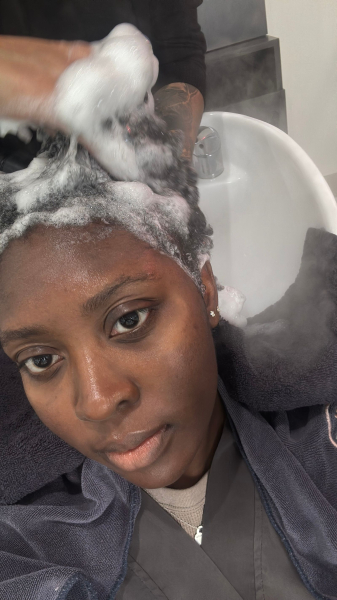
I arrived at Rëzo (a swanky spot with lots of bright white lighting and glossy floors) with my hair freshly out of braids and full of product buildup. My stylist, Iandra Regalado, immediately took me to the shampoo bowl and began washing my hair with clarifying shampoo, which she rinsed and repeated. My hair and scalp needed to be thoroughly cleansed before she applied the treatment, she explained, or else it wouldn’t effectively penetrate the hair shaft and leave the intended effect: shiny, lively curls.
 Annie Blay-Tettey
On her second round of shampooing, Regalado detangled my coils with a Denman brush, a task that, in my experience, is usually done during the conditioning phase. “I actually like to detangle with this shampoo instead of a conditioner because the rich lather creates great slip that makes detangling so easy,” Regalado told me. To my surprise, my tight coils slipped right through the brush with no tension. Needless to say, I’ll be using this method in all my wash days moving forward.
The treatment
Once my hair and scalp were clean (but not squeaky clean), we began the first step of the treatment: the Repair solution, which cosmetic chemist Amanda Lam says is pretty simple, formulaically speaking. “The formula includes 23 amino acids that are able to, according to Olaplex, penetrate the hair cortex to replenish keratin and re-link disulfide bonds to improve curl-ability of hair,” she explains. Regalado applied it to my hair in sections and raked through until each strand was evenly coated.
After we waited 10 minutes for that to sink in, she applied Enhance, a curl-defining spray that Lam says contains trisodium ethylenediamine disuccinate. That’s a chelator that binds to free metal ions found in tap water. “This helps prevent free radical damage on the hair and reduces hair breakage, which then would correlate to enhancing the curls because healthier hair equals less frizz,” she says.
Regalado spritzed it onto my hair in small sections, brushed it through, then let it sit for another 10 minutes. Many hair treatments (like keratin, for example) take three to six hours because each product involved has to “marinate” for about 30 minutes, so I was pleasantly surprised when Regalado explained that each step of the Olaplex treatment only needs to sit for 10 minutes. (There was no rinsing between steps, either.)
The last product and step of the process is Define, a hair gel that Lam notes is chock-full of moisturizing and hydrating agents like olive oil, coconut oil, and glycerin. Regalado raked it through my damp hair in sections before putting my hair in finger coils. I mentioned that I wanted my hair styled in finger coils while Regalado applied step two. (It's best to mention your desired style at the start of the appointment or anytime before the last step starts).
The styling step took the longest—and I mean the longest, because Regalado twisted very small—like, pencil-width—sections to achieve an ultra-defined look. She started at 4:30 p.m. and wrapped the last strand around 5:47. The gel seemed fairly light as I watched her apply it, and I was impressed by how well my hair absorbed it. It did give me a little heart attack at first because it went on white, but it disappeared by the time I’d even sat down at the hooded dryer.
The results
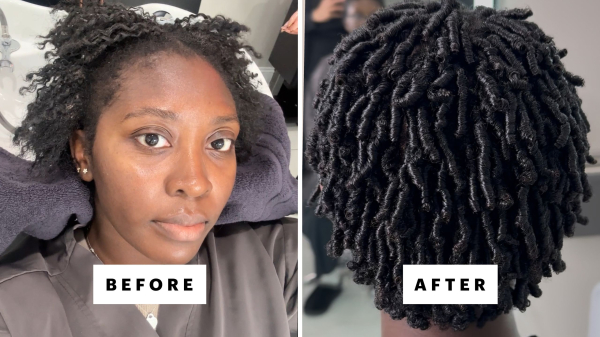
The best word I can think of to describe how I felt once my hair was done is: Cute. After my hair finished drying, each twist looked delicate, detailed, shiny, and bouncy—a far cry from the brittle, frizzy curls I walked in with. I never thought my hair could look this healthy.
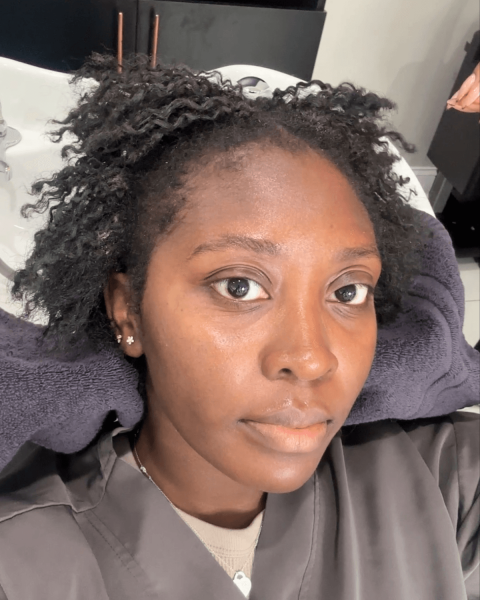
My hair before the Olaplex Bond Shaper Curl Rebuilding Treatment.
Annie Blay-Tettey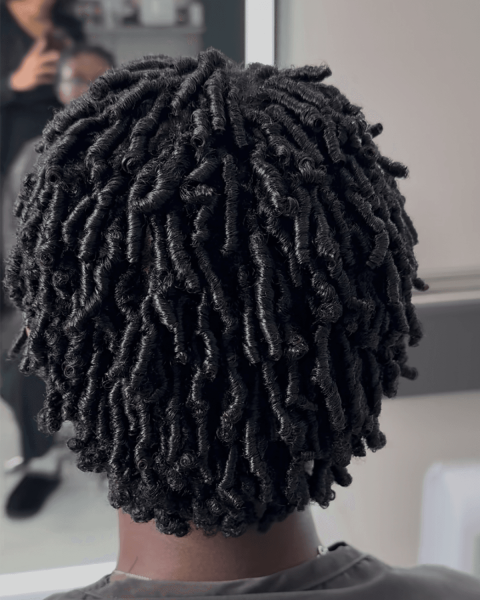
My hair after the Olaplex Bond Shaper Curl Rebuilding Treatment.
Annie Blay-Tettey
I can’t help but touch my coils throughout the day. As I’m writing this four days after the appointment, they’re still very much bouncy and defined. They have shrunken a bit (c’est la vie!), and there are a few uncooperative pieces that like to stick up at weird angles, but otherwise, I’ve been able to keep everything in place by wrapping my hair in a satin scarf every night. Oh, and I haven’t had any of that dreaded flaky residue that can come from heavily gelled, well-defined styles like this.
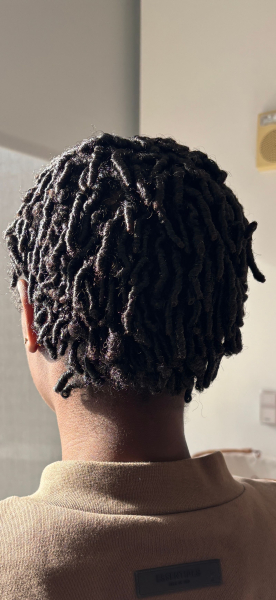
My hair five days after the Olaplex Bond Shaper Curl Rebuilding Treatment on My 4C Hair.
Annie Blay-Tettey
Regalado encouraged me to do the treatment again (which I totally would!) after my next protective style and said it's especially great for hair that’s just come out of braids and hasn’t been thoroughly hydrated for a while. Now that I think about it, after getting this treatment, my hair has shed significantly less than it usually does after taking braids down.
I was nervous that this treatment wouldn’t be truly curl-inclusive and would leave me feeling even more insecure about my texture—a fear I’ve adapted over the years as I’ve tested different curl products only to find that many don’t cater to 4C hair. But, thankfully, I couldn’t have been more wrong. While I’m still getting used to my hair being short and in its natural state, the results of this treatment have undoubtedly made it easier to embrace my natural coils.